The short version
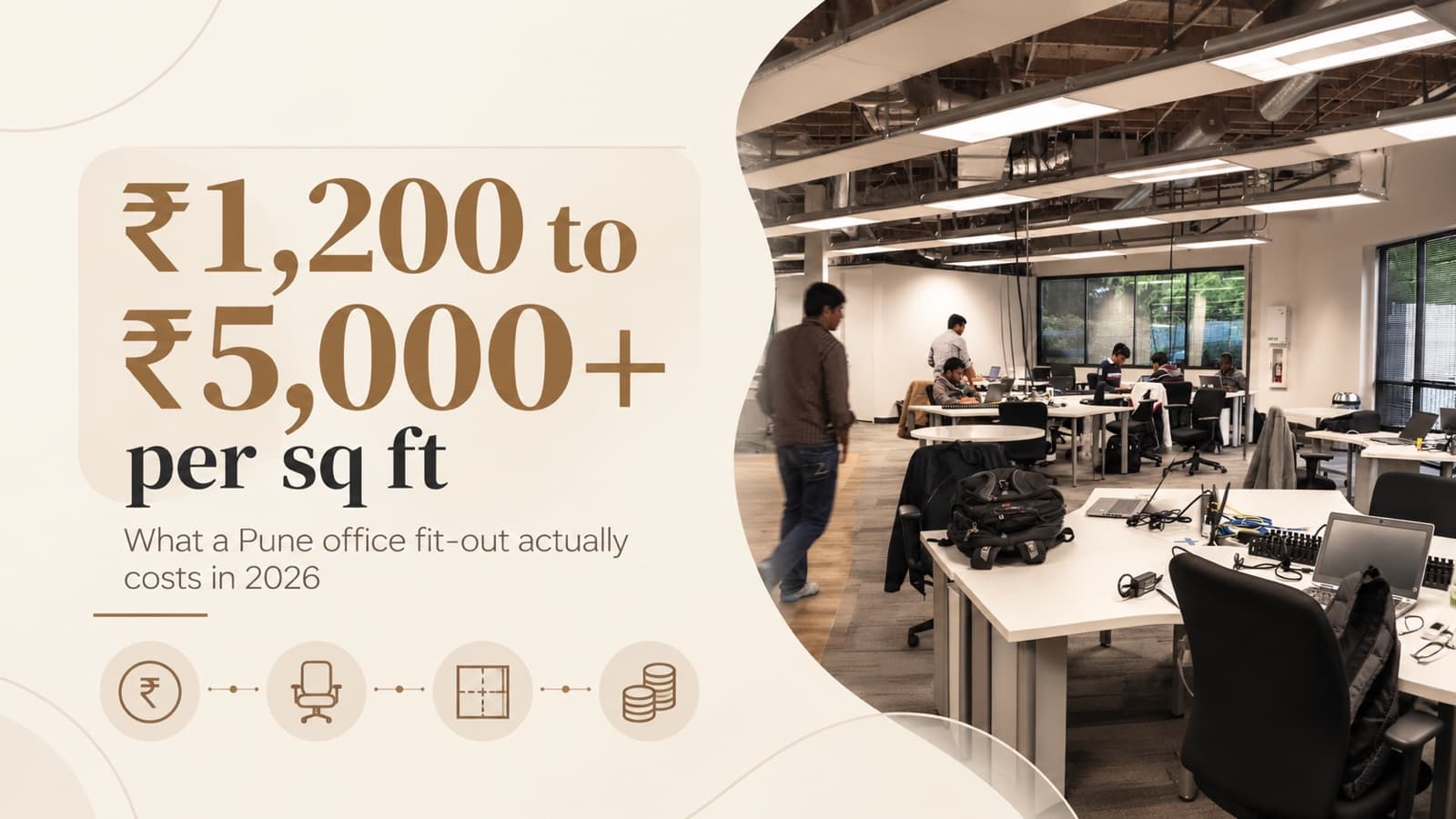
Office interior design in Pune typically costs ₹1,200 to ₹5,000+ per sq ft in 2026. Most corporate and IT offices land between ₹1,800 and ₹3,000. The final figure is decided mainly by the quality of finishes, how many cabins and meeting rooms you need, the electrical and air-conditioning scope, and the condition of the shell you start from. A 2,000 sq ft office therefore ranges from about ₹24 lakh to over ₹1 crore, which is why the per-sq-ft rate on its own tells you very little until you know what it includes.
You have signed a lease, or you are about to, and someone needs a number for the board. The trouble with office fit-out pricing is that the headline rate is almost meaningless on its own: two Pune quotes at the same ₹2,000 per sq ft can differ by twenty percent once you read what each one excludes.
This guide breaks the range into bands, shows what a 1,000, 2,000 and 5,000 sq ft office costs, explains where the budget goes, and lists the lines that quotes routinely leave out, so you can compare proposals on equal terms rather than on the number at the bottom.
The per-sq-ft rate is not the price. The rate, multiplied by the area it is priced on, plus everything the quote excludes. That is the price.
Cost per sq ft in Pune: the three bands
| Band | Per sq ft | Suits | What it typically covers |
|---|---|---|---|
| Essential | ₹1,200–1,800 | Startups, small teams, back offices | Open-plan workstations, basic partitions, standard lighting and flooring, minimal branding |
| Professional | ₹1,800–3,000 | Most IT firms, agencies, growing companies | Defined meeting rooms and cabins, better acoustics and lighting, branded reception, modular furniture |
| Premium | ₹3,000–5,000+ | Corporate HQs, client-facing firms | Custom design, premium materials, smart lighting and controls, high-spec meeting rooms and AV, design-led reception |
Turnkey means design, civil and partition work, electrical, air conditioning, furniture, lighting, finishing and project management delivered as a single package by one party.
Published guides disagree with each other, and it is worth knowing why: they define "basic" and "premium" differently. One Pune guide puts basic at ₹1,400–1,800 and mid-range at ₹1,900–3,000. Another lists a corporate office at ₹1,400–2,500. A third quotes mid-range at ₹1,500–2,500 and premium from ₹2,500 to ₹5,000+. Several turnkey firms say their Pune projects simply start at ₹2,500–3,000. The bands above are a blend of those sources. None of them is wrong; they are answering slightly different questions.
What your office will cost, by size
Use these to sense-check a budget before you speak to anyone.
| Office size | Essential | Professional | Premium |
|---|---|---|---|
| 1,000 sq ft · 10–15 people | ₹12–18 L | ₹18–30 L | ₹30–50 L+ |
| 2,000 sq ft · 25–35 people | ₹24–36 L | ₹36–60 L | ₹60 L–1 Cr+ |
| 5,000 sq ft · 60–80 people | ₹60–90 L | ₹90 L–1.5 Cr | ₹1.5–2.5 Cr+ |
These are the per-sq-ft bands multiplied out. They exclude GST, any furniture bought outside the package, and landlord or society charges. For scale, one Pune commercial guide estimates a 5,000 sq ft corporate office at roughly ₹60 lakh to ₹1.25 crore depending on specification, which sits across the Essential and Professional bands above.
Where the money actually goes
A fit-out budget is not one number, it is a stack of categories. Knowing the split is how you spot a quote that is thin in the wrong place.
| Component | Share |
|---|---|
| Furniture and fixtures: workstations, chairs, storage, meeting tables | 35–45% |
| Electrical, plumbing and air conditioning (MEP) | 25–30% |
| Civil work and partitioning: walls, glass, false ceilings, flooring | 15–20% |
| Branding and finishing: reception, signage, graphics, paint | 5–10% |
| IT, networking and security: cabling, access control, CCTV | 5–10% |
| Design and project management | 5–8% |
Two things follow from that split.
Furniture and MEP together are usually well over half the budget. Cutting back on partitions or paint saves very little. The specifications for workstations and air conditioning are what actually move the total.
Design and project management is the smallest line, and it controls every other one. A tight plan prevents rework, and rework is the most expensive thing that happens on any site.
Seven things that move the rate
1. Material and finish quality
The gap between laminate and veneer, standard and designer lighting, or vinyl and engineered stone flooring is the single biggest swing between bands. It is also the easiest thing for a quote to be vague about.
2. Open plan versus cabins and meeting rooms
Enclosed rooms cost more per square foot than open workstations, because each one needs walls, a door, acoustic treatment, its own air conditioning and usually AV. A floor plan with eight cabins is a different project from the same area left open.
3. Electrical and air-conditioning scope
Extra cooling for a server room or for dense seating, additional power capacity, and re-routing existing services all add up. MEP is the line most commonly underestimated at quotation stage.
4. The condition of the space
A bare shell, a previously fitted office that needs stripping out, and an older building each cost differently. Published guides suggest site condition alone can shift the total by roughly 15 to 25%.
5. Headcount density
More people per square foot means more workstations, more power points and more cooling load. Density is a cost driver, not just a layout decision.
6. Technology and AV
Video-conferencing rooms, projectors, structured cabling and smart controls are frequently absent from the cheapest quotes, not because they are not needed but because leaving them out makes the number look better.
7. The timeline
Compressing a schedule to meet a lease deadline typically carries a premium of roughly 12 to 18%, because it means extra crews and overtime. Green certification such as IGBC or LEED, where it is required, can add a further 10 to 20%.
Cost by type of business
| Business type | Per sq ft |
|---|---|
| Corporate office | ₹1,400–2,500 |
| IT or startup office | ₹1,200–2,000 |
| Medical clinic or consultancy | ₹1,400–2,200 |
| Retail showroom or experience centre | ₹1,200–2,500 |
| Restaurant or café | ₹1,500–3,000 |
These are mid-range values; premium specifications in any of these categories run higher. If your office is client-facing (a law firm, a financial advisory, an architecture practice, anyone who hosts investors), the reception and the boardroom are part of how you are judged before the meeting starts. Those businesses usually choose the Professional or Premium band for that reason rather than for comfort.
How Pune compares with other cities
| City | Per sq ft |
|---|---|
| Pune | ₹1,900–3,000 |
| Hyderabad | ₹2,000–3,200 |
| Bengaluru | ₹2,200–3,500 |
| Delhi-NCR | ₹2,400–3,600 |
| Mumbai | ₹2,500–3,800 |
Pune is consistently described as the most economical of the major metros for office fit-outs, with guides putting it roughly 15 to 25% below the larger cities. At the very top end the picture changes: Cushman & Wakefield's fit-out research puts Grade A corporate floors in Pune at around US$65 per sq ft. That is not comparable to a typical local quote, but it shows how quickly cost climbs once you are specifying a full corporate floor.
How long an office interior takes
| Office size | Design | Execution | Total |
|---|---|---|---|
| 1,000–2,500 sq ft | 2–3 weeks | 3–4 weeks | 30–45 days |
| 2,500–5,000 sq ft | 3–4 weeks | 4–5 weeks | 45–60 days |
| 5,000–10,000 sq ft | 4–5 weeks | 6–8 weeks | 60–90 days |
Highly customised projects run longer. The usual causes of delay are landlord and society approvals, and long-lead items such as imported furniture and AV. Start the design phase before your lease or notice-period deadline. Design and approvals can run in parallel with the lease negotiation, and that is free time most companies do not use.
The costs quotes leave out
Two quotes at the same per-sq-ft figure can end up 15 to 20% apart once the exclusions surface. Ask every designer, in writing, whether each of these is in or out:
- GST, usually quoted separately
- AV and video-conferencing equipment
- Structured cabling and networking
- Extra air-conditioning capacity, including server-room cooling
- Loose furniture (chairs, sofas, accessories) as opposed to fixed workstations
- Signage and branding elements
- Society, landlord and fire-department approvals and any deposits
- Debris removal and site clean-up
- Contingency, a buffer of 5 to 10% is normal practice
A good quote lists all of these line by line and says which are included. The same principle applies to how you pay: we set out what a fair schedule looks like in how interior payments should be staged, and the clauses worth refusing.
Eight ways to spend less without looking cheap
- Spend where clients and staff actually look. Reception, meeting rooms and lighting. Keep back-of-house simple.
- Choose modular furniture. Faster to install, cheaper to replace, and it moves with you.
- Use glass partitions selectively. They look excellent and they are expensive. You do not need them everywhere.
- Fix the electrical layout early. Moving power points after the walls are up is one of the costliest changes on site.
- Layer the lighting instead of buying expensive fittings everywhere. Good lighting design usually costs less than premium fixtures.
- Finalise the brief before work starts. Mid-project changes are the single biggest cause of overruns.
- Give the project enough lead time. A rushed schedule costs 12 to 18% more for the same result.
- Phase the build. Fit out what you need now and leave the expansion zone basic until you grow into it.
How to compare two quotes
Before you sign anything, check that each quote:
- States the carpet area it is priced on, not built-up, which is 25 to 30% larger
- Names materials and brands by specification, rather than saying "premium"
- Separates civil, MEP, furniture, IT and design fees
- Shows what is excluded, explicitly
- Gives a payment schedule tied to milestones, not to dates
- Includes a timeline with start and handover dates
- Offers a defect liability period and post-handover support
Where we sit
We are a Pune and Mumbai design studio working on commercial fit-outs, sales offices and sample flats for developers, alongside complete homes. On every project the scope, a BOQ with named brands and the exclusions list go into the contract before any payment is taken, and Divya reviews each one personally.
How a project actually runs, from brief and site study through space planning, concept and 3D visuals, line-by-line costing, execution with a single point of contact, then handover and snagging, is set out in our process. You can see completed work in our case studies, or compare us with other interior designers in Pune.
We have deliberately not published our own rate card on this page. Office fit-out pricing depends too much on the shell, the brief and the services scope for a single number to be useful, and a rate quoted without a scope is how buyers end up comparing two things that are not alike. Send us the plan and we will give you a real one.
Common questions
How much does office interior cost per sq ft in Pune?
Published market guides put Pune office interiors at roughly ₹1,200 to ₹5,000+ per sq ft in 2026. Simpler fit-outs run ₹1,200–1,800, the mid band where most IT and corporate offices land is ₹1,800–3,000, and design-led premium work starts around ₹3,000. Your own figure depends on finishes, how many cabins and meeting rooms you need, the services scope and the condition of the shell.
How much does it cost to design a 1,000 sq ft office in Pune?
Roughly ₹12–18 lakh at the simpler end, ₹18–30 lakh in the mid band, and ₹30–50 lakh or more for premium work. These are the per-sq-ft ranges multiplied out, before GST and before any landlord or society charges.
What is the cost of a 2,000 sq ft office interior in Pune?
Around ₹24–36 lakh at the simpler end, ₹36–60 lakh in the mid band, and ₹60 lakh to ₹1 crore or more for premium work. A 2,000 sq ft floor typically seats 25 to 35 people depending on how many cabins and meeting rooms you build.
Is a turnkey office interior cheaper than hiring contractors separately?
Not always cheaper on paper, but usually better controlled. Splitting civil, electrical, furniture and IT across separate vendors can look less expensive until you count the coordination, the delays when one trade waits on another, and the gaps between warranties. A turnkey contract puts one party in charge of the result.
How long does an office interior project take?
Offices of 1,000 to 2,500 sq ft typically take about 30 to 45 days from design to handover. 2,500 to 5,000 sq ft runs 45 to 60 days, and 5,000 sq ft and above 60 to 90 days or longer. Landlord and society approvals, and long-lead furniture or AV, are the usual causes of delay.
Does the quote include GST and furniture?
Often not. Many office quotes exclude GST, loose furniture such as chairs and sofas, AV equipment and structured cabling. Ask for a written list of inclusions and exclusions before you compare two numbers. The gap between quotes is frequently in what is left out rather than in the rate.
What affects office interior cost the most?
Material and finish quality, the number of private cabins and meeting rooms, the electrical and air-conditioning scope, the condition of the shell you are starting from, and how tight the timeline is. Furniture and services together are usually more than half the budget.
Can I renovate an existing office instead of a full fit-out?
Yes. Refreshing layout, lighting, flooring and furniture in a space that is already fitted out generally costs less than building from a bare shell, though stripping out old services can add to the bill. A site visit is needed before anyone can give you an accurate figure.
Why do two quotes at the same per sq ft rate differ so much?
Because the rate is only meaningful alongside the area it is priced on and the list of what it covers. One quote may be on carpet area and another on built-up, which differs by 25 to 30%. One may include air conditioning and networking while the other does not. Always compare the inclusions before the rate.
Cost ranges on this page are indicative market averages compiled from published 2026 Pune and India fit-out guides (Citi Design Studio, Flipspaces, Uniworks Designs and Officebanao) and from Cushman & Wakefield's fit-out cost research. They are not a quotation, and they are not Divya Jain Interiors' rate card.