The short answer. A full turnkey interior for a villa or bungalow in Pune costs roughly ₹1,600–2,100 per sq ft at an Essential finish, ₹2,200–2,850 at Premium and ₹2,850–3,850 or more at Luxury, before loose furniture. For a typical 4,000 sq ft, two-level villa that is about ₹65 lakh to ₹1.5 crore. Expect about 24 weeks from first brief to handover: six weeks of design, sixteen on site, two of finishing and snagging. An older bungalow, a third level or imported stone makes it longer.
Search for what a villa interior costs in Pune and you find a lot of apartment pricing. The guides that rank are almost all built around 1, 2 and 3 BHK flats, the few that mention villas give one national range with no breakdown, and nobody shows you what happens in which week. That is a problem, because a villa is not a large flat. It has a staircase, several bathrooms, rooms two storeys high, a garden or terrace, and its own water tank, power backup and security, all things a building handles for an apartment owner.
This guide gives you both halves: what it costs, using our own published rates next to what the rest of the market quotes, and how the work runs week by week on a typical Pune villa. Where a figure is ours we say so. Where it comes from another firm's published guide we name it, because several of those guides contradict themselves and you should know whose number you are reading.
Cost per sq ft: the three finish levels
Our cost estimator prices independent homes per sq ft of the floor area being fitted out across every level, with a factor for the extra work a villa carries over an apartment. These are the rates it uses for Pune in 2026, for a full turnkey interior covering design, modular joinery, fixed furniture, lighting and styling:
| Finish level | Typical rate | Range we quote | What it looks like |
|---|---|---|---|
| Essential | ₹1,840 | ₹1,600–2,100 | Quality laminates, good national hardware, a clean ceiling and lighting plan |
| Premium (Elevated Lux) | ₹2,530 | ₹2,200–2,850 | Veneers and lacquers, richer detailing, layered lighting, feature walls |
| Luxury (Ultra Lux) | ₹3,335 | ₹2,850–3,850 + | Bespoke joinery, imported fittings and stone, fully styled |
Excludes loose furniture and white goods. The range reflects how much specification moves the number inside a finish level, which is why we quote a range rather than one figure.
How that compares with the market
Other published figures sit in the same territory. HomeLane puts Pune interiors at ₹1,800–3,500 per sq ft in 2026, without saying whether that is carpet or built-up area. NoBroker's national bands, updated in May 2026 and applied to built-up area, are ₹1,000–1,500 per sq ft for budget work, ₹1,500–2,500 for mid-range and ₹2,500–4,500 or more for premium. NoBroker sells interiors, and its own page caps villa projects at a figure below its table's floor, so treat it as one firm's marketing range rather than a market fact.
Two things to check whenever you compare rates. First, which area the rate is on: built-up area is commonly 25 to 30 per cent more than the floor you actually furnish, so the same project looks cheaper per sq ft on built-up. Second, what is in it. A rate that includes joinery but not flooring or lighting is not comparable with one that includes both.
What your villa will cost, by size
The same rates multiplied out across the sizes we see most often in Pune, from a 2,500 sq ft row house to a 6,500 sq ft independent bungalow:
| Area fitted out | Typically | Essential | Premium | Luxury |
|---|---|---|---|---|
| 2,500 sq ft | Row house, G+1, 3–4 bedrooms | ₹40–52 L | ₹56–71 L | ₹71–96 L |
| 4,000 sq ft | Villa, G+1, 4 bedrooms | ₹65–82 L | ₹89 L–1.13 Cr | ₹1.13–1.53 Cr |
| 5,000 sq ft | Villa or bungalow, G+1 or G+2 | ₹81 L–1.03 Cr | ₹1.11–1.42 Cr | ₹1.42–1.92 Cr |
| 6,500 sq ft | Independent bungalow, G+2 | ₹1.05–1.34 Cr | ₹1.45–1.84 Cr | ₹1.84–2.49 Cr + |
For comparison, NoBroker prices a 2,500–4,000 sq ft villa or duplex at ₹35–55 lakh for budget work, ₹56–85 lakh mid-range and ₹86 lakh to ₹1.5 crore premium. At the bottom of the size range our Essential figure sits above their budget band, because our Essential still means a designed home with a lighting plan and named-brand hardware rather than a package.
What the number covers, and what sits on top
Our turnkey figures include design, modular joinery, fixed furniture, lighting and styling. On an apartment that is most of the job. On a villa, a handful of large items can sit inside or outside the quote depending on the shell you are starting from, and they are where two quotes for the same house most often differ.
Flooring
A villa has a lot of floor, and a staircase, so the choice of stone moves the budget more than in a flat. Installed rates in Pune, material plus laying, from Studio Matrx's flooring guide (checked June 2026):
| Material | Installed, per sq ft | On 4,000 sq ft |
|---|---|---|
| Vitrified tile | ₹75–160 | ₹3–6.4 L |
| Granite | ₹130–320 | ₹5.2–12.8 L |
| Indian marble | ₹160–400 | ₹6.4–16 L |
| Large-format slab tile | ₹180–380 | ₹7.2–15.2 L |
| Engineered wood | ₹350–800 | ₹14–32 L |
| Italian / imported marble | ₹450–1,200 + | ₹18–48 L + |
Statuario and Calacatta can go past ₹1,500–2,000 per sq ft installed. Imported marble reaches Pune through Mumbai or Kishangarh importers, so it can cost slightly more here once transport is added. Skirting, dado and waterproofing are not in these rates. Most villas mix materials: stone in the living, dining and stair, tile or wood in the bedrooms, anti-skid outdoors.
The kitchen
Villa kitchens are bigger, and often have an island, a utility area or a second wet kitchen. NoBroker's Pune figures for modular kitchens by layout, updated November 2026: straight ₹1.5–4.5 lakh, L-shaped ₹2–5.5 lakh, parallel ₹2.5–6.5 lakh, U-shaped ₹2.8–7 lakh and island ₹3.5–8 lakh or more. A large villa kitchen with an island and a separate utility area will sit at or above the top of that range. Our modular kitchen cost guide breaks this down further.
The rest of the list
- Bathrooms. A four-bedroom villa commonly has five or six. NoBroker's national figure is ₹60,000 to ₹3 lakh each, and in a villa the count matters as much as the rate.
- Civil changes. Moving walls, widening openings, adding a skylight. Priced only after a site survey.
- Home automation, CCTV and networking. Lighting scenes, curtains, gate and intercom, Wi-Fi that reaches every floor. The cabling has to go in before the ceilings close, so decide on it in design.
- Outdoor areas. Deck, pergola, terrace seating, garden lighting, landscaping.
- Loose furniture, curtains, rugs, art and white goods. Excluded from our figures and from most others, and on a villa a substantial line of its own.
Why a villa costs more per sq ft than a flat
A villa does not just have more area. It has categories of work an apartment of the same size simply does not have. These are the things that move the rate, roughly in order of how much they move it:
- Imported materials. NoBroker puts imported brands at 40 to 100 per cent more than standard, and national premium brands at 15 to 25 per cent more. Stone, sanitaryware and kitchen hardware are where most villa owners choose imported.
- Double-height spaces. A living room two storeys high needs scaffolding for the ceiling and lights, taller panelling and curtains, and a feature wall big enough to hold the room. It costs far more per sq ft of floor than an ordinary room.
- The staircase. Cladding, railing, a lit wall alongside it, often storage underneath. In a flat it does not exist; in a villa it is the first thing a guest sees.
- Number of levels. A G+2 has more stair, more vertical services and more material carried upstairs than a G+1 of the same area. Every extra level adds cost and adds weeks.
- Bathroom count. Villas typically have more bathrooms per bedroom than flats, plus a powder room, and every one needs waterproofing, tiling, fittings and a vanity.
- Independent-home systems. Water storage and pressure pumps, power backup, solar, security, gate automation. A building handles these for an apartment owner.
- Outdoor and terrace areas. Treated as rooms rather than leftover space, they need weather-proof materials and lighting.
- Timeline pressure. NoBroker estimates a rush job adds 20 to 35 per cent. On a villa, with more trades to compress, that is a large number.
The trade-off is that a villa also gives you room to do things a flat cannot: a courtyard, a library under the stair, a proper home office, a kitchen that opens to a garden. Most of the extra cost buys something you can see.
The timeline at a glance
The large interior companies publish apartment timelines, and they are a useful baseline. Livspace quotes about 90 days for a full home. Design Cafe quotes 60 days from design sign-off, plus a 15–30 day design phase before it. NoBroker gives 12 to 16 weeks for a 4 BHK. On our own apartment projects, site work runs 60 to 90 days.
None of them publishes a villa timeline, and none of the villa timelines we found online held up when we checked where they came from. So the schedule below is ours: how we plan a typical villa, not a figure borrowed from someone else.
| Phase | Weeks | Duration | Your involvement |
|---|---|---|---|
| Brief, survey and design | 1–6 | 6 weeks | Heavy: layouts, materials, sign-offs |
| Civil and services | 7–10 | 4 weeks | Light: one walkthrough of electrical points |
| Floors, ceilings and carpentry | 11–17 | 7 weeks | Moderate: weekly site visit |
| Installation and finishes | 18–22 | 5 weeks | Moderate: fixtures and styling choices |
| Snagging and handover | 23–24 | 2 weeks | Joint snag walk, then keys |
Kitchen and wardrobe production runs in a factory in parallel from week 7, so it does not add time on site as long as the joinery drawings are signed on schedule.
Week by week: a 4,000 sq ft villa from brief to keys
This is the plan for a two-level, four-bedroom villa handed over by the builder with basic flooring and bathrooms, done at a Premium finish. A bungalow needing demolition and new services, a third level or imported stone stretches it, and section seven covers how.
| Week | On the drawing board | On site |
|---|---|---|
| Week 1 | Brief: how the family lives, who uses which floor, what stays | Measured survey of every level; audit of existing wiring, plumbing, water tank, backup and drainage |
| Week 2 | Two or three space-planning options | Structural check if any wall or slab change is proposed |
| Week 3 | Layout frozen; concept and mood boards; long-lead list drawn up | |
| Week 4 | 3D views of the living, dining, stair and master bedroom; stone and material selection visits | |
| Week 5 | Working drawings: electrical, plumbing, ceiling, joinery, automation | |
| Week 6 | BOQ with named brands, contract signed; stone, kitchen, imported fittings and automation ordered | Community permissions for work hours, material movement and debris |
| Week 7 | Joinery drawings released to the factory | Site protection; demolition and civil changes begin |
| Week 8 | Wall changes, new openings, chasing for conduits on both floors | |
| Week 9 | Electrical conduit and wiring; plumbing lines; AC copper piping | |
| Week 10 | Electrical point walkthrough with you | Bathroom waterproofing and ponding test; data, CCTV and automation cabling |
| Week 11 | Ground-floor flooring; bathroom tiling | |
| Week 12 | First-floor flooring; staircase cladding | |
| Week 13 | Ground-floor false ceiling; scaffolding in the double-height space | |
| Week 14 | First-floor false ceiling; on-site carpentry begins: panelling, TV wall, bed backs | |
| Week 15 | Carpentry continues; putty and primer where ceilings are closed | |
| Week 16 | Kitchen and wardrobes leave the factory | Ground-floor kitchen and wardrobe installation |
| Week 17 | First-floor wardrobes; countertops templated and fitted | |
| Week 18 | Paint coats; stone polishing | |
| Week 19 | Light fittings, switches, sanitaryware and fittings | |
| Week 20 | Automation commissioning; appliances; glass and mirrors | |
| Week 21 | Deck, pergola, terrace and garden lighting; final paint coat | |
| Week 22 | Styling plan confirmed | Wallpaper, curtains, loose furniture delivered |
| Week 23 | Deep clean, styling, joint snag walk | |
| Week 24 | Handover pack: warranties, as-built electrical and plumbing drawings | Snags closed, keys handed over |
Weeks 1–6: design, and the decisions that cannot wait
Six weeks is longer than an apartment needs, and it should be. A villa has more rooms, more levels and more systems, and every one of them has to be resolved on paper before anyone breaks a wall. The most important output of these weeks is not the 3D views. It is the long-lead list: the stone, the kitchen, imported sanitaryware, automation hardware and anything else that takes weeks to arrive. These get ordered in week 6, so they reach site when the schedule needs them rather than holding it up.
This is also where your time is most needed. A layout decision that takes a week here costs a week; the same decision changed in week 12 costs demolition.
Weeks 7–10: civil and services, the invisible month
Nothing you will photograph happens in these four weeks, and they matter more than any others. Every conduit, pipe, drain and cable for both floors goes in now, along with the bathroom waterproofing and its ponding test. In a villa this includes the work a building would otherwise do: pump and tank connections, backup wiring, gate and CCTV cabling, garden lighting circuits. Once the ceilings close in week 13, adding any of it means breaking finished work.
We walk you through every electrical point in week 10, room by room, on site. It is the cheapest moment in the whole project to change your mind.
Weeks 11–17: floors, ceilings and carpentry
Floors go down a level at a time, ground floor first so the first floor can be reached without crossing wet stone. The staircase is clad once the floors at either end are done. False ceilings follow, with the double-height space needing its own scaffolding and usually its own week. Meanwhile kitchen and wardrobe units have been in production since week 7, and they arrive in week 16 to a site that is ready for them.
Weeks 18–22: installation and finishes
Paint, polish, lights, fittings, automation, appliances, glass. Then the outdoors: deck, pergola, terrace and garden lighting, kept late so they are not damaged by work inside. The final coat of paint goes on after everything that might mark a wall has been installed.
Weeks 23–24: snagging and handover
A villa has more snags than a flat simply because it has more of everything. We walk the house with you, list everything, close it, and hand over the keys with the warranties and the as-built electrical and plumbing drawings. Those drawings are the most underrated thing you will receive: in a villa, where you own every pipe and cable, they are what any future electrician or plumber needs.
What delays a villa in Pune
Livspace lists the generic causes of delay as material availability, delivery, customer feedback and design approvals, and all four apply. On villas in Pune, these are the ones we plan around specifically:
- The monsoon. Pune's rains run roughly June to September. Interior work carries on, but terrace and external waterproofing, decks, landscaping and exterior paint are best done outside those months, and damp slows paint and polish curing. Our monsoon guide covers the materials side.
- Decisions made late. The single most common cause. A stone chosen in week 10 instead of week 4 can hold the floors, which holds the ceilings, which holds the carpentry.
- Imported materials. Stone, fittings and hardware from abroad take longer to arrive and longer to replace if a slab is damaged. Ordering in week 6 is the protection.
- Surprises in older bungalows. Rotten plumbing, undersized wiring, damp walls and uneven slabs only show up once you open them. Section eight covers this.
- Community rules. Gated villa communities set working hours, material entry times and debris rules. They are reasonable, but a schedule written without them will slip.
- Changing scope mid-way. Adding a room, an automation system or a lift after the services are in costs time on every trade that has already passed through.
A new villa vs an older bungalow
Pune has two quite different kinds of independent home. Newer villa communities and row houses, mostly on the city's edges, are handed over as a shell with basic finishes, and the interior is an interior job. Older bungalows in neighbourhoods like Koregaon Park, Aundh and Kalyani Nagar are often decades old, and the interior is really a renovation.
The finish level can be the same in both. The difference is everything that has to come out first. An older bungalow typically needs rewiring to modern loads, replacement of old plumbing, fresh waterproofing on terraces and bathrooms, levelling of floors and sometimes structural repair. That adds both cost and weeks to the civil and services phase, and the honest way to price it is a site survey before any number is given. Anyone quoting an older bungalow from the drawings alone is guessing.
If the house has character worth keeping, original flooring, a staircase, a verandah, keeping it is often cheaper than replacing it, and usually better. Our luxury renovation work is mostly this.
Fees, payments and contingency
What the designer charges
There are three common ways to pay for design on a villa, and they suit different owners:
| Model | Our fee | On a 4,000 sq ft villa | Suits |
|---|---|---|---|
| Design only | ₹90–250 per sq ft, by finish | ₹3.6–10 L | Owners with their own trusted contractor |
| Design and supervision | 8–10% of project value | ₹7–9 L at Premium | Owners who want to buy materials themselves |
| Turnkey | 5% of project value, inside the contract | Included in the figures above | Owners who want one party responsible for the result |
NoBroker puts designer fees more broadly at 8 to 15 per cent of project cost, or a fixed fee. Our guide to interior designer charges in Pune covers the models in detail, and turnkey vs design-only covers which one fits whom.
How payments should be staged
On a 24-week villa, payments should follow progress, not the calendar: a booking amount, then stages tied to design sign-off, completion of services, carpentry and handover. Never pay most of the contract before the civil and services phase is done. Our payment schedule guide sets out what a fair schedule looks like.
Contingency
Market guides commonly advise 10 to 15 per cent. On a villa we would treat the upper end as sensible if the house is older, if you are changing layouts, or if stone and lighting are not finalised before work starts. On a new villa with a frozen design and a fixed-scope BOQ, the lower end is usually enough.
A villa we delivered in Aundh
Everything above is our own pricing and our own planning template. Here is one independent home it came from, so you can check the numbers against something real rather than against a range.
| What | This project |
|---|---|
| Home | Independent bungalow, two levels, Aundh |
| Area fitted out | 4,060 sq ft |
| Scope | Full turnkey, design and execution in-house |
| Time on the job | Six months, brief to handover |
| Finish level | Luxury |
Two things are worth reading off that. The six months sits almost exactly on the twenty-four week plan in section 6, which is the schedule that template was built from rather than a number we worked backwards to. And the per-square-foot figure lands inside the Luxury band in section 1, though not at the bottom of it, because a double-height living room, a clad staircase and a carved stone entrance are the parts of an independent home that a flat never has to pay for.
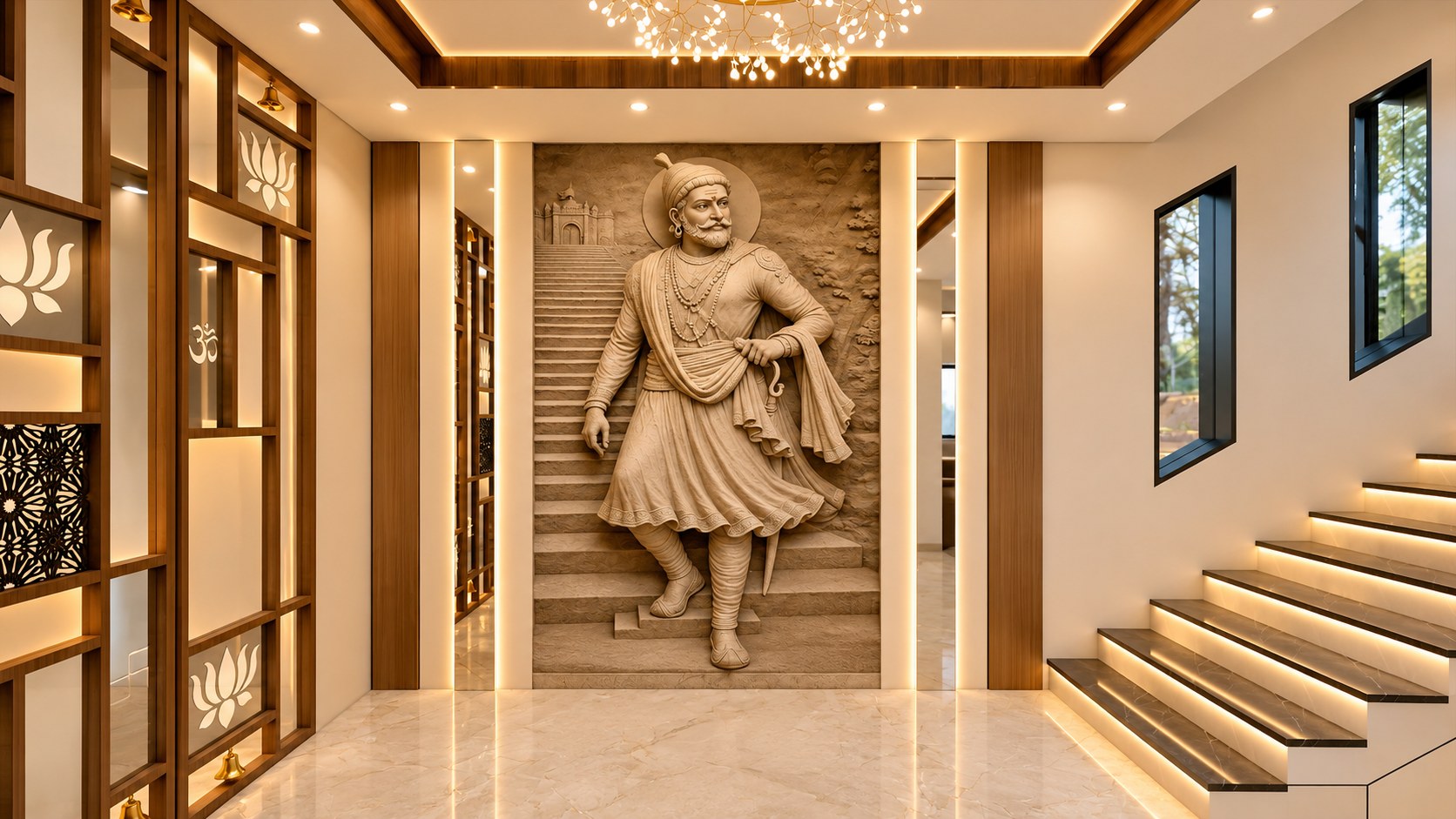
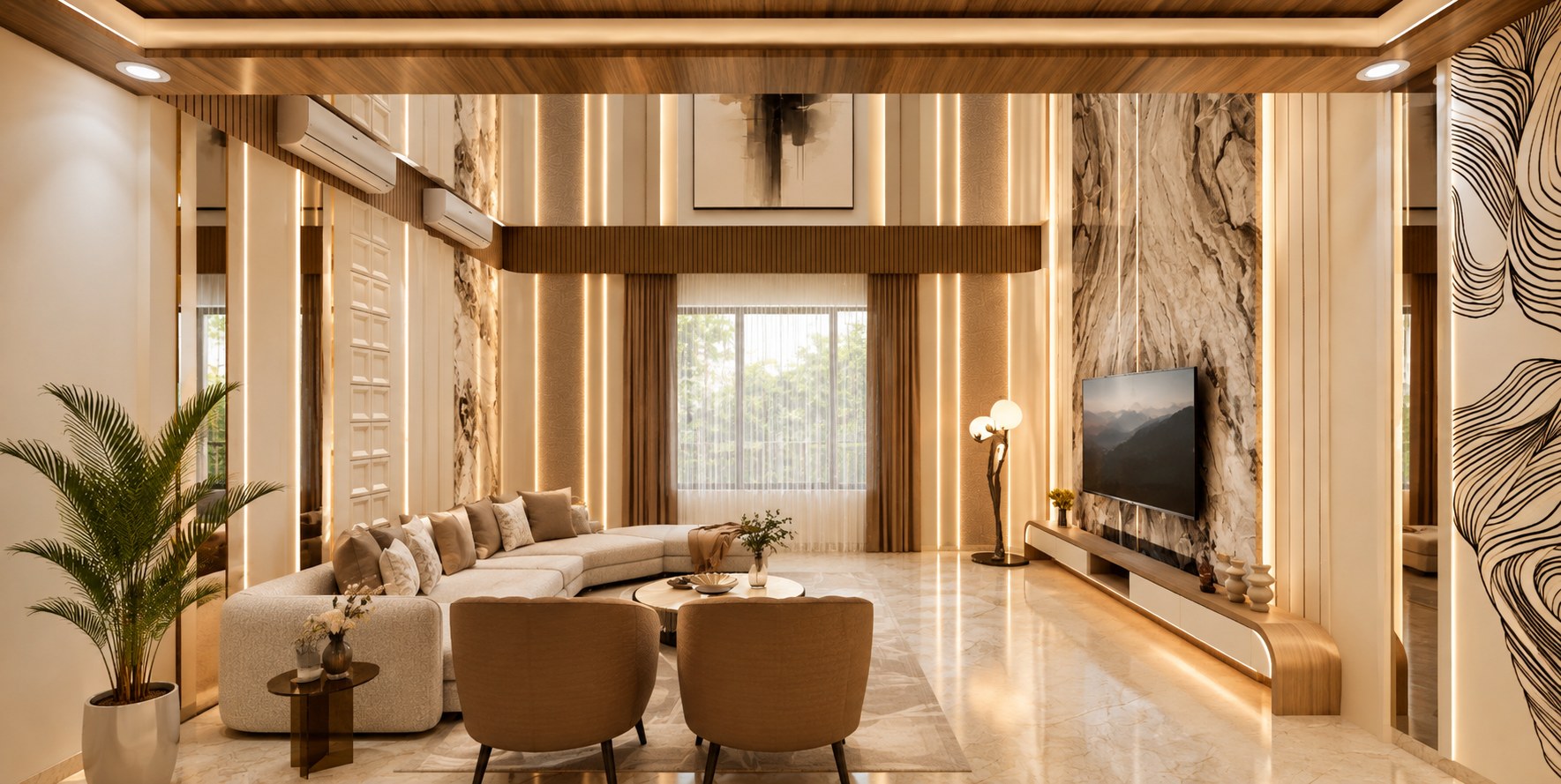
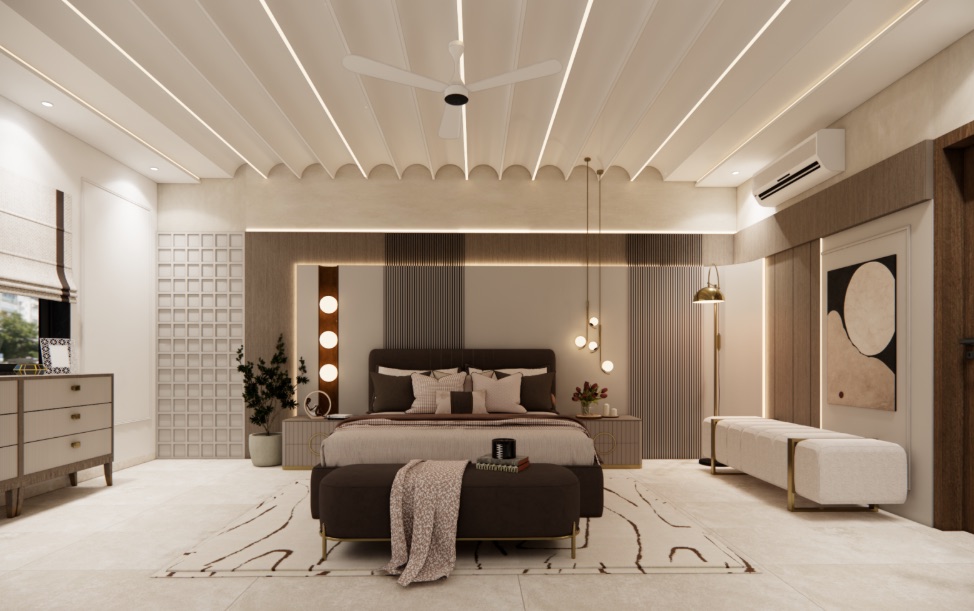
The rooms, the materials and what each space actually looks like are on the project page: the Aundh bungalow, room by room.
Where we sit
We are a Pune and Mumbai studio, practising since 2016, and independent homes are where design and execution under one roof matters most. On every project the scope, a BOQ with named brands and the exclusions go into the contract before any payment is taken, and Divya reviews each one personally. You can see how we approach villas and penthouses and bungalows and row houses, or browse completed work.
Frequently asked questions
How much do villa interiors cost per sq ft in Pune?
In our own pricing, a full turnkey villa or bungalow interior in Pune works out at roughly ₹1,600–2,100 per sq ft at Essential finish, ₹2,200–2,850 at Premium and ₹2,850–3,850 or more at Luxury, before loose furniture. Published guides land in a similar place: HomeLane quotes ₹1,800–3,500 per sq ft for Pune interiors, and NoBroker's national bands run from ₹1,000 to ₹4,500 or more.
What does a 4,000 sq ft villa interior cost in Pune?
About ₹65–82 lakh at Essential finish, ₹89 lakh to ₹1.13 crore at Premium, and ₹1.13–1.53 crore or more at Luxury, for a full turnkey interior. Depending on the shell, new flooring, civil changes, home automation, landscaping and loose furniture can be priced on top, so ask which of them a quote includes.
How long does a villa interior take?
Plan on about 24 weeks from first brief to handover for a typical 4,000 sq ft, two-level villa: roughly six weeks of design and documentation, sixteen weeks on site and two weeks of finishing and snagging. An apartment takes us 60 to 90 days on site. An older bungalow that needs civil and services work, a third level, or imported stone pushes the schedule longer.
Why does a villa cost more per sq ft than a flat?
Because almost everything a building handles for a flat becomes yours. A villa has a staircase to clad and light, more bathrooms per bedroom, double-height spaces that need scaffolding and taller joinery, outdoor areas, and its own water, power backup and security systems. Each of those is work an apartment of the same area simply does not have.
Is it cheaper to do the interiors one floor at a time?
It spreads the payments, but it rarely saves money. Mobilising twice, protecting a finished floor while the other is worked on and re-booking trades usually costs more than it saves, and the staircase and services that join the floors have to be designed once for the whole house anyway.
Should I start villa interiors during the monsoon in Pune?
Interior work carries on through the monsoon, but plan around it. External waterproofing, terrace and deck work, landscaping and exterior paint are best finished before June or after September, and damp weather slows paint and polish curing. Doing the design during the monsoon so that site work begins as it ends is a common and sensible sequence.
What do interior designers charge for a villa in Pune?
Fee models differ. With us, design-only is ₹90–250 per sq ft depending on finish, design and supervision is 8–10% of project value, and inside a turnkey contract the design fee is 5% of project value. NoBroker puts designer fees more broadly at 8–15% of project cost. For a 4,000 sq ft villa, design-only works out at about ₹3.6–10 lakh.
How much contingency should I keep for a villa?
Market guides commonly advise 10 to 15 per cent. On a villa we would treat the upper end as sensible if the house is older, if you are changing layouts, or if stone and lighting are not finalised before work starts.
Does renovating an older bungalow cost more than doing a new villa?
Usually yes per sq ft, because you pay to remove before you build: old wiring and plumbing, tired waterproofing, uneven floors and sometimes structural repairs. The finish level can be identical. The only honest way to price it is a site survey before a quote.
Key takeaways
- 1A turnkey villa or bungalow interior in Pune costs roughly ₹1,600–2,100, ₹2,200–2,850 or ₹2,850–3,850+ per sq ft at Essential, Premium and Luxury finish, before loose furniture.
- 2A 4,000 sq ft villa runs about ₹65 lakh to ₹1.5 crore. Flooring, civil work, automation, landscaping and furniture are where two quotes differ, so compare inclusions before rates.
- 3Plan on about 24 weeks: six of design, sixteen on site, two of snagging. An older bungalow, a third level or imported stone adds time.
- 4The decisions that protect the schedule are made in weeks 1–6: layout, stone, kitchen and automation. Order long-lead items before site work starts.
- 5Keep the monsoon for design and interior work, and the terrace, deck and exterior for the dry months.
Divya Jain Interiors' rates on this page are those used by our cost estimator in 2026 and are indicative, not a quotation. The week-by-week schedule is our own planning template for a typical project. Market figures are attributed to the firms that publish them: HomeLane (May 2026), NoBroker's full-home and Pune modular kitchen guides (May and November 2026), Studio Matrx's Pune flooring guide (June 2026), and the published timelines of Livspace and Design Cafe. They are those firms' figures, not ours.